


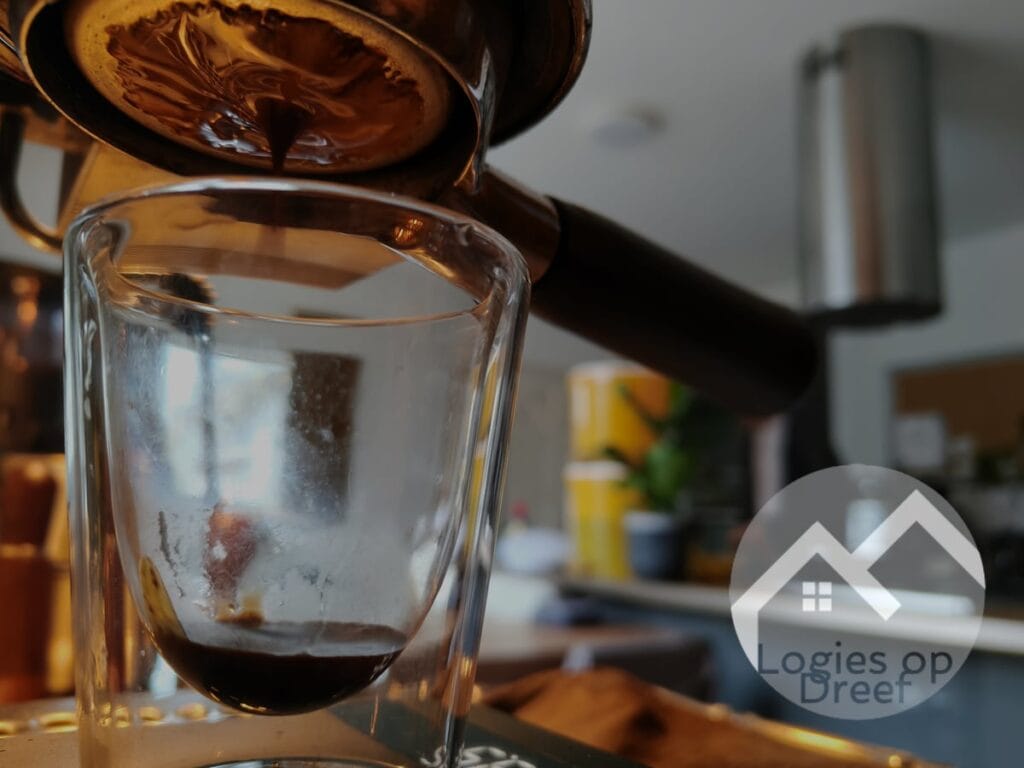
Half past nine on a quiet morning in Driebergen. The mill is turning, the scent of freshly ground beans fills the kitchen. Outside, mist hangs between the trees of the Utrechtse Heuvelrug. Inside, the first drops of espresso fall into a warmed cup. Dark brown, slow, just right.
This is the moment I seek out again every morning. And it is exactly this method that I share in our Barista Workshop. The same steps professional baristas use, translated to your own kitchen at home. No tricks, no expensive equipment. Just an approach that takes your espresso to another level, step by step.
At Logies op Dreef in Driebergen, every studio has an espresso machine with freshly roasted specialty coffee beans from Keen Coffee Roastery. That is deliberate. Among all the unique accommodations on the Utrechtse Heuvelrug, this is the place where coffee is not an afterthought. Whoever wakes up on this special accommodation on the Utrechtse Heuvelrug deserves a morning that starts with artisan-brewed espresso. Not with a capsule.

What is the difference between espresso and regular coffee?
Espresso is not a different product. It is a different method. Water is forced through finely ground coffee under high pressure. This yields more flavor per milliliter than filter coffee, drip, or French press.
The difference is not in the bean. You can make espresso using the same specialty coffee beans that you use for filter coffee. The secret lies in the grind, the pressure, and the precision. And you can learn that precision.
How do you make espresso step by step like a home barista?
Making espresso is all about repetition. Follow the same steps every time and adjust no more than one thing at a time. That is the fastest way to learn what works.
Which beans do you need for a good espresso?
Freshness is everything. Coffee is a fresh product, just like bread. Check the roasting date on the packaging and use the beans within six to eight weeks of roasting. After that, most of the aromas will have disappeared.
What should you look for? Beans should be matte, not shiny. Shiny beans are too oily and leave residue in your machine. Single origin often has more character than a blend. And the season plays a role: roasters adjust their profiles, meaning your espresso tastes different in winter than in summer.
At Logies op Dreef I work with freshly roasted specialty beans from Coffee Roastery Keen in Utrecht. Artisanally roasted, delivered fresh, a different origin every month. In our studios, the jar with the roasting date on it is on display. So you know it is fresh.
My rule of thumb: never buy pre-ground espresso. As soon as you grind a bean, the volatile aromas start to evaporate. Within fifteen minutes, most of it is gone. Invest in a decent grinder. It makes more of a difference than an expensive machine.
Why does the grind make such a big difference when making espresso?
The grind size determines how fast water flows through the coffee. And with that, the taste of your espresso.
Ground too coarsely? The water rushes through it within fifteen seconds. The result: a sour, watery espresso. In coffee jargon, this is called under-extraction. You are not getting enough flavor out of the bean.
Ground too finely? The water drips out after forty seconds. Result: a bitter, ash-like taste. This is over-extraction. You are extracting too much from the bean, including the bitter substances.
Just right? An extraction time of 25 to 30 seconds for 35 to 40 ml of espresso. The grind size is the barista tip that makes the biggest difference. Start with your grinder's recommended setting. Make a shot. Too fast? One click finer. Too slow? One click coarser. Never two clicks at once.
How many grams of coffee do you use for a single and double espresso?
A single espresso uses 7 to 9 grams for approximately 25 ml. A double: 18 to 20 grams for 35 to 40 ml. The principle remains the same. Only the quantity changes.
How do you know that exactly? Use a scale that is accurate to the gram. That saves frustration and gives you control over the result.
After weighing comes the distribution. When you pour ground coffee into the portafilter, you often end up with a heap with a peak. If you press it down like that, an uneven bed is created. And water seeks the path of least resistance.
My method: poke through the coffee with a needle or toothpick to separate the clumps. Gently shake the portafilter horizontally. A distribution tool also works fine. Choose what works for you, but do not skip this step.
How do you tamp level and consistently?
It's not about force. It's about leveling and pressing down consistently. You press the air pockets out of the coffee so that water flows evenly through the entire bed.
This is how I do it:
- Place the portafilter on a flat surface.
- Place the tamper perpendicular to the coffee
- Press down gently until you feel resistance
- Check that the surface is level (look from the side)
- Crooked? Try again
Why is a spirit level so important? If you tamp at an angle, you get channeling. The water carves a path through the thin part. The rest remains untouched. You can see it in your espresso: part of it runs light, part dark. It doesn't taste good.
What should you pay attention to during the extraction and the crema?
Everything is prepared. Now comes the moment of truth. Place the portafilter in the machine and start immediately.
What you see during the extraction:
- First five seconds: nothing, or thick dark drops (the pre-infusion)
- Seconds five to fifteen: the espresso starts flowing, dark brown
- Seconds fifteen to twenty-five: the color becomes lighter, reddish-brown
- Seconds twenty-five to thirty: ends golden yellow, hazelnut brown
The crema tells you if it's done. Hazelnut brown, sometimes with tiger stripes (dark spots). Thick enough to hold a spoonful of sugar for a moment. No crema? Then your beans are probably too old.
Take a sip immediately when the espresso is ready. Pure, without sugar or milk. Too acidic? Grind finer or use more grams. Too bitter? Grind coarser or use fewer grams. Numbers are guidelines, not laws. I have had espressos that were perfect after 22 seconds.

How do you serve an espresso properly?
This is the step most home baristas skip. And it makes more difference than you think.
Warm your cup. Rinse it with hot water or place it on the warm machine. An espresso in a cold cup loses its temperature within thirty seconds. And with it, part of the flavor.
Serve immediately after extraction. Espresso becomes bitter within two minutes if left to stand. Traditionally, you place a glass of still water next to it. Not to wash away the taste, but to reset your palate between sips. The little ritual of a warmed cup and a glass of water next to your espresso: now that is true luxury.
A guest told me that on the second morning of her stay, she served an espresso to her partner on the terrace. With a glass of water on a small tray. Spontaneously, without anyone having explained it to her. She had seen it the day before and adopted it. That is the moment the ritual begins.
What mistakes do home baristas make most often?
In all the years I have been serving guests with espresso at Logies op Dreef, I see the same mistakes recurring time and again. These are the five most common.
- Use old beans. Check the roast date. Little crema and a flat flavor are the symptoms.
- Do not weigh. Always 18 to 20 grams for a double. A scale prevents guesswork.
- Distribute unevenly and tamp. Level first with a needle, then tamp horizontally. Otherwise, you will get channeling.
- Do not preheat the machine. Let your machine run for ten to fifteen minutes. Rinse with water before you start.
- Do not keep the portafilter clean. Rinse after every shot. Clean weekly with cafiza. You can taste a dirty portafilter immediately.
In our B&B studios with their own espresso machine I see guests unlearn these mistakes in two days. Not through theory, but by practicing again every morning.
Why is freshly roasted specialty coffee indispensable?
Your espresso is 98 percent water. If your tap water is hard or chlorinated, you will taste it. A simple water filter helps enormously.
Temperature also plays a role. Most machines keep themselves between 90 and 96 degrees. Too hot results in a burnt taste. Too cold leads to acidic under-extraction. Does your machine have a PID controller? Set it to 93 degrees.
But it starts with the beans. Artisanally roasted specialty coffee from a local roastery like Koffiebranderij Keen gives you beans with character. Supermarket brands cannot match that. The difference lies in the freshness, the care taken during roasting, and the traceability of the origin.
When is the best time for an espresso retreat in the Utrechtse Heuvelrug?
Each season has its own coffee ritual on the Utrechtse Heuvelrug.
In spring and autumn, the forests around Driebergen are at their most beautiful. The temperature is ideal for a walk after your morning espresso. Combine it with a Beekeeping Workshop in the spring. Taste fresh honey from our own bees and then walk through the Utrechtse Heuvelrug National Park.
Summer offers the longest mornings. Combine the Barista Workshop with beekeeping. Brew espresso on the terrace while hearing the bees buzzing in the garden. Taste honey with your breakfast, right in the middle of the forest. That is not a holiday. That is a different way of life.
Winter is the ultimate retreat. Outside, mist and silence. Inside, the ritual of freshly ground beans in your private studio, overlooking the forest. No agenda, no obligations. Just you and the sound of the mill.
An espresso retreat is not just about learning to make coffee. It is a morning without haste, with fresh honey with your breakfast and walking trails that start at the front door. A base in nature where you return to what truly matters. Those seeking this will find it at Original overnight stay on the Utrechtse Heuvelrug.
From reading to doing: the Barista Workshop in Driebergen
Reading is one thing. Doing is another. It is only when you are standing there grinding, tamping, and seeing what that espresso looks like yourself that it clicks.
That is why I give the at Logies op Dreef Barista Workshop package in Driebergen. In two hours, we go through all the steps together on a professional machine. You make your own mistakes. We analyze what happens together. And we adjust it immediately until you get that perfect shot.
Tired of manuals and YouTube videos that don't work for your situation? This is a workshop and overnight stay combined that you won't find anywhere else. A barista workshop in the Utrecht region where you not only learn, but also practice afterwards. Every morning, in your own studio with espresso machine in Driebergen.
Studio Upstairs (45 square meters) or Studio Downstairs (13 square meters): both with a private entrance and complete privacy. No shared hallway, no breakfast bell. Your pace, your espresso, your morning.
Espresso in a private studio or coffee in a hotel: what do you choose?
Imagine this. You wake up in a hotel. The clock radio is tuned to a station you didn't choose. Downstairs, the breakfast buffet awaits with scrambled eggs under a heat lamp. In the room, there is a Nespresso machine with two capsules. That is the coffee experience most people know.
Now imagine it differently. You wake up in a private studio. Outside, a blackbird is singing in the garden. You walk to the kitchen and grind fresh beans. No one asks you anything. No lobby, no other guests, no sign on the door. Just the sound of the grinder and the aroma of freshly ground coffee.
Not the luxury of marble and room service. The luxury of silence, a private kitchen, and espresso you brewed yourself. With a view of the National Park. No castle hotel with shared corridors here. No eco-lodge without a kitchen. An authentic farmhouse from 1922 where the private studio is all your own.

If you've had enough of always being reachable, of having to sociable with strangers at breakfast, you will find something different here. Peace and nature, combined with the privacy to structure your morning exactly as you wish. That is Unique overnight stay with nature, luxury, and privacy. Romantic overnight stay for those who choose depth over crowds.
The transformation
Maybe you recognize it. The mornings that start in a rush. Bad coffee out of habit. Always reachable, never fully present. The first sip of lukewarm filter coffee while you're already looking at your phone.
Here, that changes. Not through a course or a book. Through the ritual itself. Grinding beans in silence. Listening to the mill. Watching the crema form. Two minutes without a screen, without an agenda. It sounds small, but it feels bigger than you expect.
Guests often tell me the same thing. On the first morning, it feels awkward. On the second morning, it becomes a choice. On the third morning, it is a ritual they no longer want to miss. They leave different than when they arrived. Not because the coffee was so good (although that helps). But because their morning was their own again.
Whether you come for a weekend away in Utrecht, An romantic stay or a place where peace is the standardThe morning always starts the same here. With fresh beans, silence, and the time to make something beautiful out of it.
Something has shifted. Not in your schedule. In how your mornings start.
Quieter. Slower.
More conscious.
Discover where nature, privacy, and craftsmanship come together
